

BIM & DIGITAL DELIVERY FOR CONSTRUCTION
Structured BIM processes, clean data and reliable handover — from scan to as-built.
We manage BIM workflows, models and asset data to ensure consistency, compliance and predictable digital delivery across the project lifecycle.

[ For whom is this service intended ]
This service is designed for teams who need control over BIM processes, data quality and information handover — without building internal BIM management capacity.
Main Contractors (Design & Build)
You need structured BIM delivery aligned with programme and handover
You want predictable, compliant information at every stage
Developers & Asset Owners
You need accurate asset data for handover and FM
You want confidence that models reflect what was actually built
Engineering & Design Consultancies
You need BIM management support aligned with ISO 19650
You want consistent standards across multiple disciplines
Facilities Management Teams
You rely on COBie and asset data for operations
You need clean, validated information — not spreadsheets full of gaps
[ When This Service Is Most Valuable ]
This service is especially effective when:
BIM processes are inconsistent across teams

COBie data is required but poorly structured

Scan data needs to be converted into reliable BIM models

Information handover is unclear or delayed

Project teams lack BIM management capacity
[ PROBLEMS WE SOLVE ]
What Slows Projects Down

Models exist, but data is incomplete or unreliable

COBie datasets are delivered late or fail validation

Scan data is underused or incorrectly interpreted

No clear BIM ownership or coordination process

Handover information does not match the as-built condition
[ WHAT YOU GET ]
Clear deliverables. Structured data. Reliable handover.
We deliver more than models — we deliver structured BIM environments that support construction, handover and operation.

Scan to BIM Conversion
- Point cloud processing and alignment
- Accurate as-built geometry
- Models reflecting real site conditions
COBie Data Creation & Validation
- Structured asset data aligned with UK standards
- Data validation and gap resolution
- COBie datasets ready for handover and FM systems
BIM Management & Coordination
- BIM Execution Planning support
- Information management aligned with ISO 19650
- Model coordination and issue tracking
Revit Content & Family Creation
- Custom parametric families
- Manufacturer-aligned content
- Consistent data structure across models
Drawing Production
- Construction and record drawings derived from validated models
- Consistent documentation aligned with BIM data

[ PROJECT CONTROL & VISIBILITY ]

Controlled Information Exchange
- Clear responsibility for model updates
- Structured Common Data Environment workflows

Data Quality Assurance
- Regular audits of geometry and information
- Validation before submission or handover
[ FINAL OUTPUTS ]

Verified BIM models

Validated COBie datasets

As-built / record models

Structured digital handover aligned with client requirements

[ WHAT THIS MEANS FOR YOU ]
-

Confidence in BIM data quality
-

Faster, cleaner handover
-

Reduced FM data issues
-

Compliance with ISO 19650 and UK BIM Framework
-

Predictable digital delivery
[ How We Work ]

We review your BEP, project standards, specifications, and modelling requirements before starting the work.

We allocate experienced BIM managers and information coordinators tailored to your project scope — covering model management, data standards, asset information and multidisciplinary coordination.

We establish naming conventions, filters, templates, worksets, zones, and model structure in line with UK contractor standards.

We optimise MEP routes, reducing bends, excessive lengths, and clashes — following cost-efficient routing principles.

A robust Navisworks workflow: clash detection, issue tracking, service zones, access and maintenance checks, RCP alignment, and BWIC validation.

We deliver Builderwork Openings (BWIC) early in the programme, not at the end.

RCPs, layouts, schematics, and installation drawings — clean, aligned, and fully compliant with UK BIM Framework requirements.

Weekly progress summaries: % completion, variations, and time reports, with federated NWDs every week.
[ HOW IT WORKS ]
Requirements & Setup
We review EIR, BEP, data requirements and existing models or scans.

Data & Model Development
Scan conversion, modelling, data structuring and content creation.

Management & Validation
BIM coordination, data checks and issue resolution.

Delivery & Handover
Final models, COBie datasets and record documentation.

[ THE TEAM BEHIND YOUR PROJECT ]
One team. One workflow. One accountable delivery.

BIM Project Manager
Single point of contact

MEP Team Lead
Technical decisions & routing

BIM Coordinator
Clash control & federated models

BIM Technician
Modelling & drawing production

QA / Standards Lead
Сompliance & model quality
[ our bim ecosystem ]
Our workflows follow UK BIM standards and replicate contractor-side coordination processes to ensure accuracy, consistency, and seamless delivery across disciplines.







-
ISO 19650-Compliant Delivery:
We structure information, workflows, file naming, and model revisions strictly in line with the ISO 19650 series, ensuring full alignment with UK digital construction frameworks.
-
UK BIM Framework Alignment:
Our coordination and documentation processes follow the latest guidance of the UK BIM Framework, including CDE structure, model federation logic, and approval cycles.
-
COBie-Ready Data:
We deliver datasets aligned with COBie UK 2012, structured for asset management and FM teams.
-
BEP & Client Standard Integration:
We fully integrate your:
- BIM Execution Plan (BEP)
- Employer’s Information Requirements (EIR)
- Project BIM Protocol
- Contractor-specific standards
to ensure seamless onboarding and compatibility.
-
Professional Indemnity Insurance:
We are covered by Professional Indemnity (PI) Insurance, protecting clients against design and coordination risks.
-
Provider:
Underwritten by a UK-registered insurer (industry standard wording).
-
Coverage:
Coverage up to £5,000,000
Coverage aligned with UK contractor requirements.
[ WHY OUR BIM DELIVERY WORKS ]
Because BIM is about information — not just geometry.
Many projects deliver models that look complete but fail at handover.
We focus on data structure, validation and usability — ensuring BIM supports the full building lifecycle.
What Makes Our BIM Delivery Reliable
Information-First Approach
Data requirements drive modelling decisions — not the other way around.
ISO 19650-Aligned Processes
Clear information responsibility and controlled workflows.
Validated Outputs
No unchecked data delivered at handover.
Ownership & Accountability
One team responsible for BIM delivery end-to-end.

The Result
- Clean, usable BIM data
- Reliable asset information
- Smooth handover
- Reduced operational issues
BIM is only valuable if the information can be trusted.

Get BIM data and models you can rely on
[ Services ]
You will get coordinated, buildable systems that work on site — not just in the model.

BIM MEP Modelling
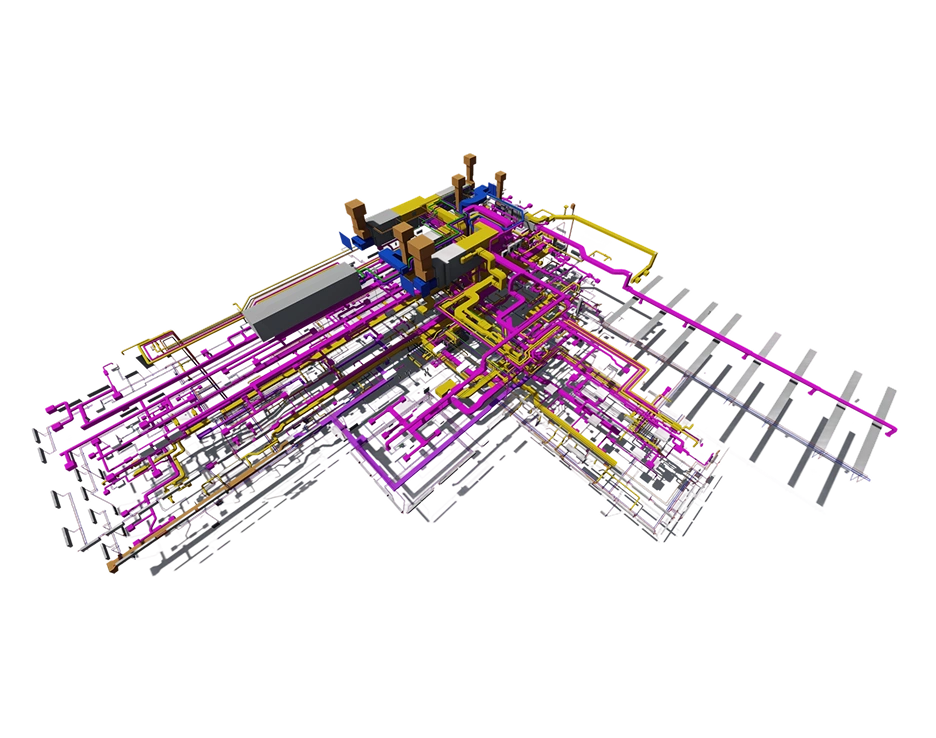
We deliver mechanical, electrical and public health BIM models that integrate seamlessly across disciplines — reducing clashes, optimising routing, and supporting smooth installation on site.
- Mechanical BIM modelling
- Electrical BIM modelling
- Public Health BIM modelling
- Multidisciplinary MEP coordination
- Installation-ready drawing production

Fire protection services
We deliver sprinkler and fire protection BIM models that integrate seamlessly with MEP, structure, and ceilings — reducing clashes, optimising hydraulic routing, and preventing costly site rework.
- Fire sprinkler systems modelling
- Wet, dry & foam systems coordination
- Hydraulic calculation support
- Installation-ready drawings
[ Success Stories from Our Clients ]
[ FAQs ]
Frequently Asked Questions
All insights into our expertise are presented in a clear and concise way. No question is too technical or too simple — we’re always happy to help.
What is BIM for all practical purposes?
When we speak about BIM or building information modeling, BIM definition may be hard to embrace at a go. The modern strategy of construction design tries to integrate each element into a consistent toolkit using BIM. This Building Information Model covers the period from the project conception to the final demolition of the building. The undeniable advantage of BIM technology is interconnectedness. When you change any parameter of a BIM model, every associated object, drawing, or visualization also changes automatically. In fact, BIM creates a unified environment with access for professionals from a variety of fields. BIM tools are used not only by the development team but also by the contractors and sub-contractors. In this way, BIM reduces the potential loss of information and provides valuable insights to the project owners. Also, the BIM meaning is undeniable in the matters of cost recovery. The annual BIM report consistently shows a high return on investment. Thus, BIM is an integral part of construction engineering development in the future.
What is a BIM model?
In a practical sense, a BIM model is structured information about a building suitable for digital processing. Building information modeling (BIM) is used within the framework of an object’s life cycle. Moreover, BIM brings together all the data available, allowing to use it for solving a variety of tasks. It becomes much easier to make specific constructive decisions using BIM. As BIM provides a link to each level of the project, one can estimate the potential functional performance. Concerning the inventory and logistics management, the advantages of BIM should not be underestimated either. With BIM cost estimating and equipment ordering won’t take a lot of effort. The result of BIM modeling is always dynamic, allowing making changes at any time. Although this significantly differs from the traditional design method, this is also why BIM projects are so promising. Nowadays the buildings’ utilization often changes repeatedly in a short time. That’s why the alterations detection and making some possible improvement is crucial.
How can Building Information Modelling (BIM) help you?
The capabilities of BIM projects allow designing or reconstructing a building anytime. It’s also getting easier to manage it as an object of commercial activity. Modern building information modeling lets to transfer the generalized and structured information for further use. Nowadays BIM software takes over the processing of constructive information. As its volume is huge for a single project, it’s extremely difficult for a person to cope with it. The collection and complex processing of the entire data volume results in a BIM model. The developed model is saturated with the information much more than the usual drawing. BIM technology is a logical stage of the standard design methods’ evolution, bringing them to the modern level.
What is BIM in construction?
Of course, fundamental decisions on design, as before, rest in the hands of people. But BIM construction performs its technical function of finding, processing, and analyzing the necessary data. BIM technology is useful for finding the inconsistencies arising when the object is designed by many different specialists. The discrepancies’ detection is a result of the continuous processing of the information submitted into a collaborative model. It becomes clear that the use of BIM in the construction sphere helps to avoid critical errors. And, of course, it allows reducing the costs significantly. This aspect underlies in the BIM level 2 development strategy. Reduction of the delivery and operational costs, along with the risk minimization characterizes this tendency the most.
What does BIM stand for?
An all-embracing approach to the object’s exploitation. It involves the collection and integrated processing of the architectural, economic, and other data in the design process. The building (structure) and everything that has to do with it is considered as a single indivisible unity.
What is BIM level 2?
A state-initiated by the methodology aimed at reducing the cost of the public sector infrastructure using BIM technology. The key point is the use of the collaborative 3D BIM models.
Need a custom BIM package?
We can combine modelling, coordination, and COBie data delivery into one tailored workflow.
Get a Consultation